
🔥FIRE SALE🔥 No. 8
Alex Katz: American Painter and Fit God at 95


A couple of weeks ago, I went uptown to see Alex Katz: Gathering, the latest retrospective at the Guggenheim. The long spiral ramp was a crescendo filled with paintings of friends, flowers, and foliage and was a testament to the steadfast excellence of a painter, who, until recently, was overlooked for much of his career. Compared to his contemporaries in the midcentury American art scene who were exploring the boundaries of abstract expressionism, Katz seemed to be coloring inside the lines. His paintings, which are comprised mostly of figurative work (although his latest work veers towards the abstract), were in a mode that was completely out of fashion in its time. Art is not competitive, no matter what the Academy of Motion Picture Arts and Sciences says, but as I hiked to the top of the museum, I couldn’t help but feel like Katz had won in a way. The world is full of enough abstractions as it is. Seeing a piece so masterfully executed, so rich, and so grounded felt shocking, even avante-garde, in comparison to the water cooler corporate abstract expressionism that populates office parks and subway advertisements.
Fashion has always had a fascination with painting. Raf Simons teamed up with American artist Sterling Ruby for Simons’s first Dior couture show in 2012, and Yves St. Laurent was famously inspired by Mondrian’s modernist masterpiece Composition with Red Blue and Yellow (1930) for his iconic fall/winter 65-66 sack dress. Katz cuts out the designer as the middleman. His paintings are populated with sharply dressed ladies and gentlemen in iconic pieces of the midcentury. Cocktail dresses, tweed blazers, and colorful ties decorate urbane scenes of American life in the American century against the hustle and bustle of the most American metropolis. Katz’s paintings which are often described as flat, vibrant, and bright, are an achievement in color composition on par with any Rothko or Kandinsky, and because they are figurative, they give the viewer a practical guide on styling oneself for the real world. But firstly, the man himself.
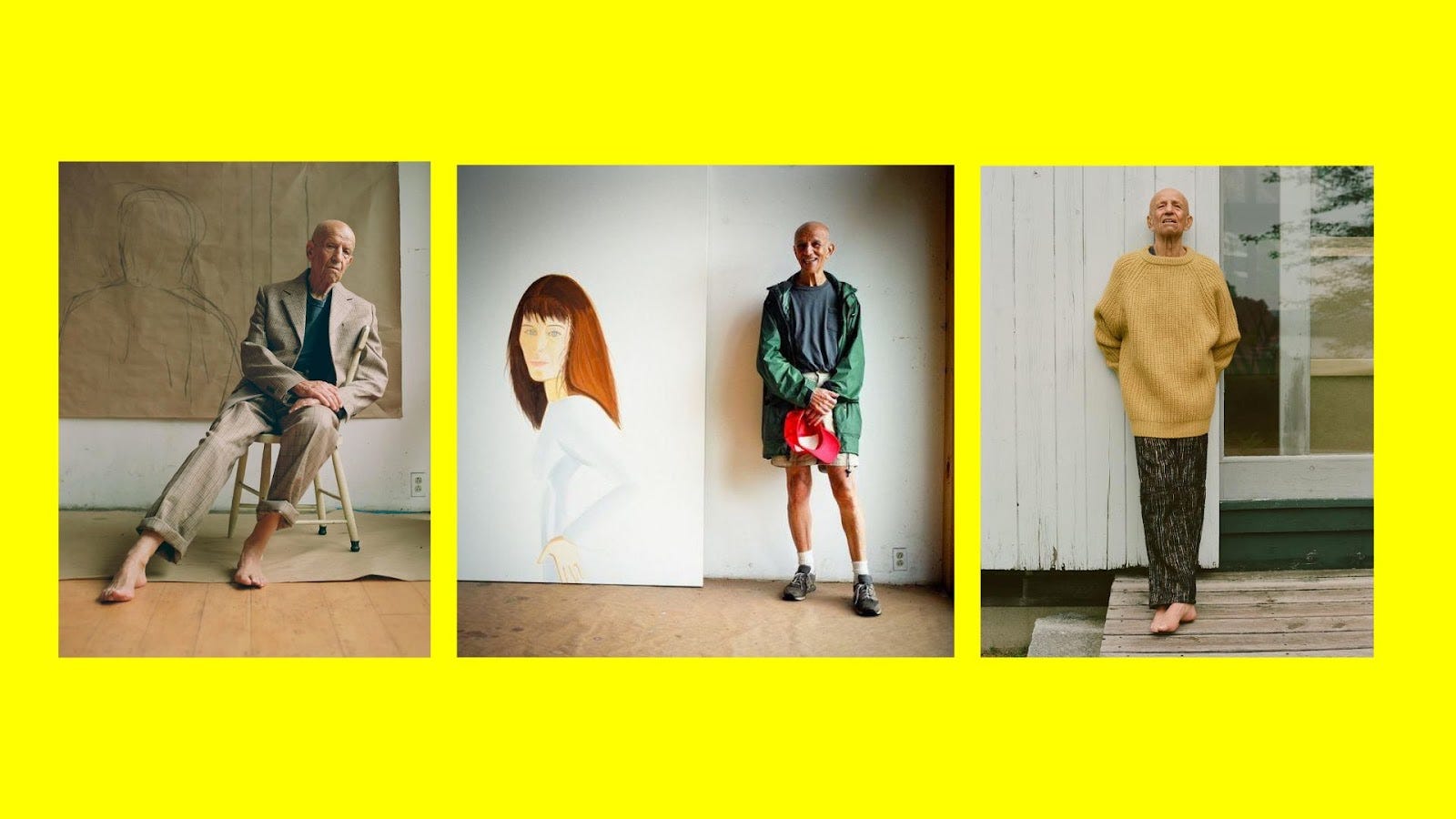
Earlier in Katz’s career, he presented himself in the uniform of the American arts intelligentsia – sportcoats, oxford shirts, and wool trousers. As he has gotten older, his style has felt more individual. Now in his 90s, Katz isn’t afraid of high-fashion editorials and styles his own wardrobe with an eye for the eccentric. Here he is in W magazine (left and right) wearing a roomy Marni suit as well as an oversized knit sweater paired with pants in a stunning texture and colorful exposed fibers. He has an effortless coastal grandpa style that could land him on the Old Jewish Men of New York's Instagram page. He’d give Mistermort a run for his money with the insane ratio of shorts-to-colossal-raincoat in a casual outfit photographed in his studio (middle).
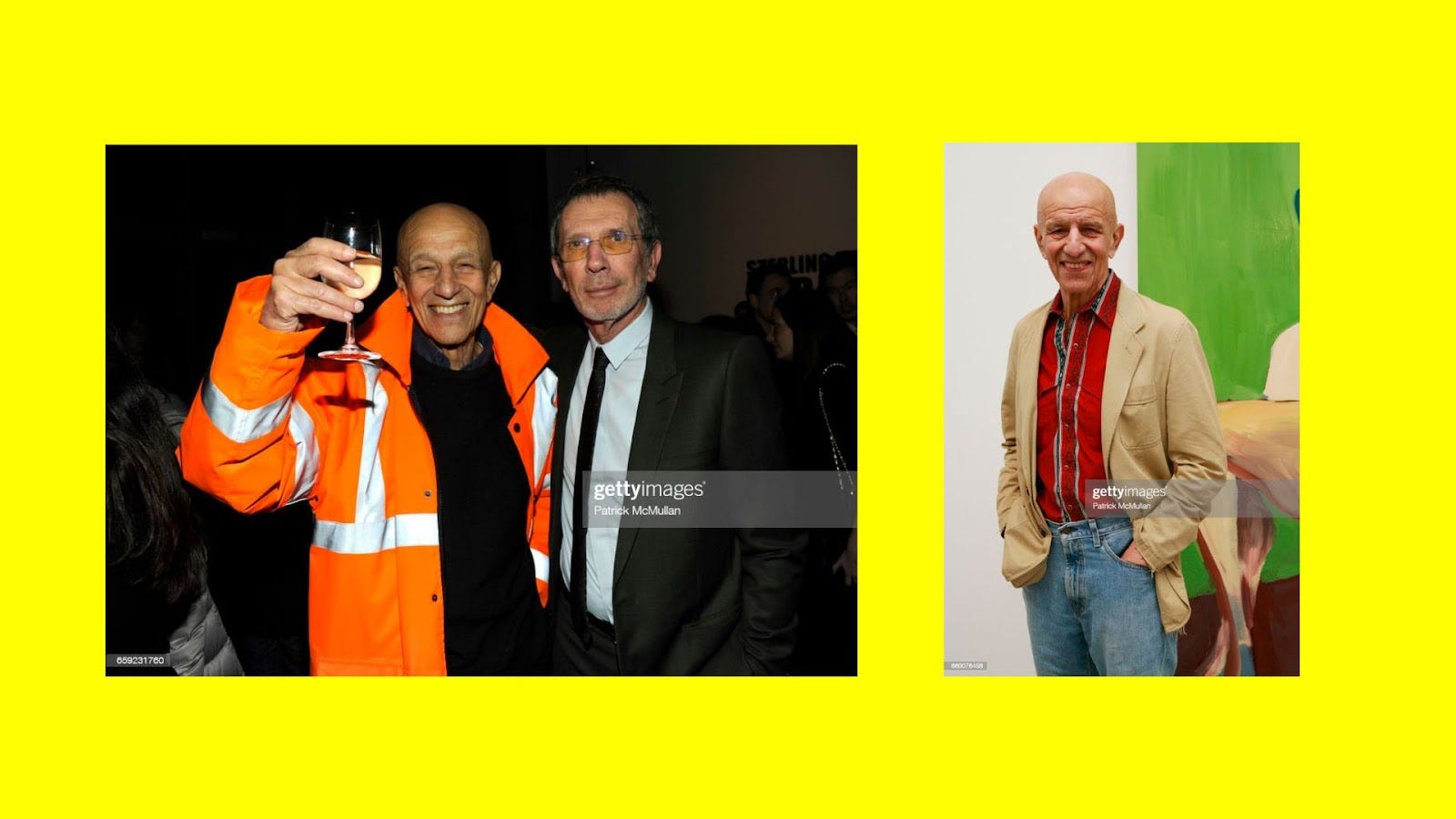
Katz’s wardrobe is eclectic. There are a number of pieces that stand out when digging through hundreds of Getty image photos from decades of gallery openings. On the left, Katz is donning a hi-vis heavy-duty rainjacket in orange at an after-party for a 2009 Sterling Ruby opening at Pace Gallery. The flash of the camera proves the jacket's efficacy. Katz’s smile shines as brightly as his coat. On the right, Katz goes toe-to-toe with Ralph Lauren in a perfect pair of straight-leg jeans, a red western shirt with Aztec trim, and a frayed khaki blazer. Katz has shown that growing older doesn’t necessarily mean establishing an uninspired uniform. He is able to dress beyond the midcentury style that is gloriously preserved in amber in his paintings.
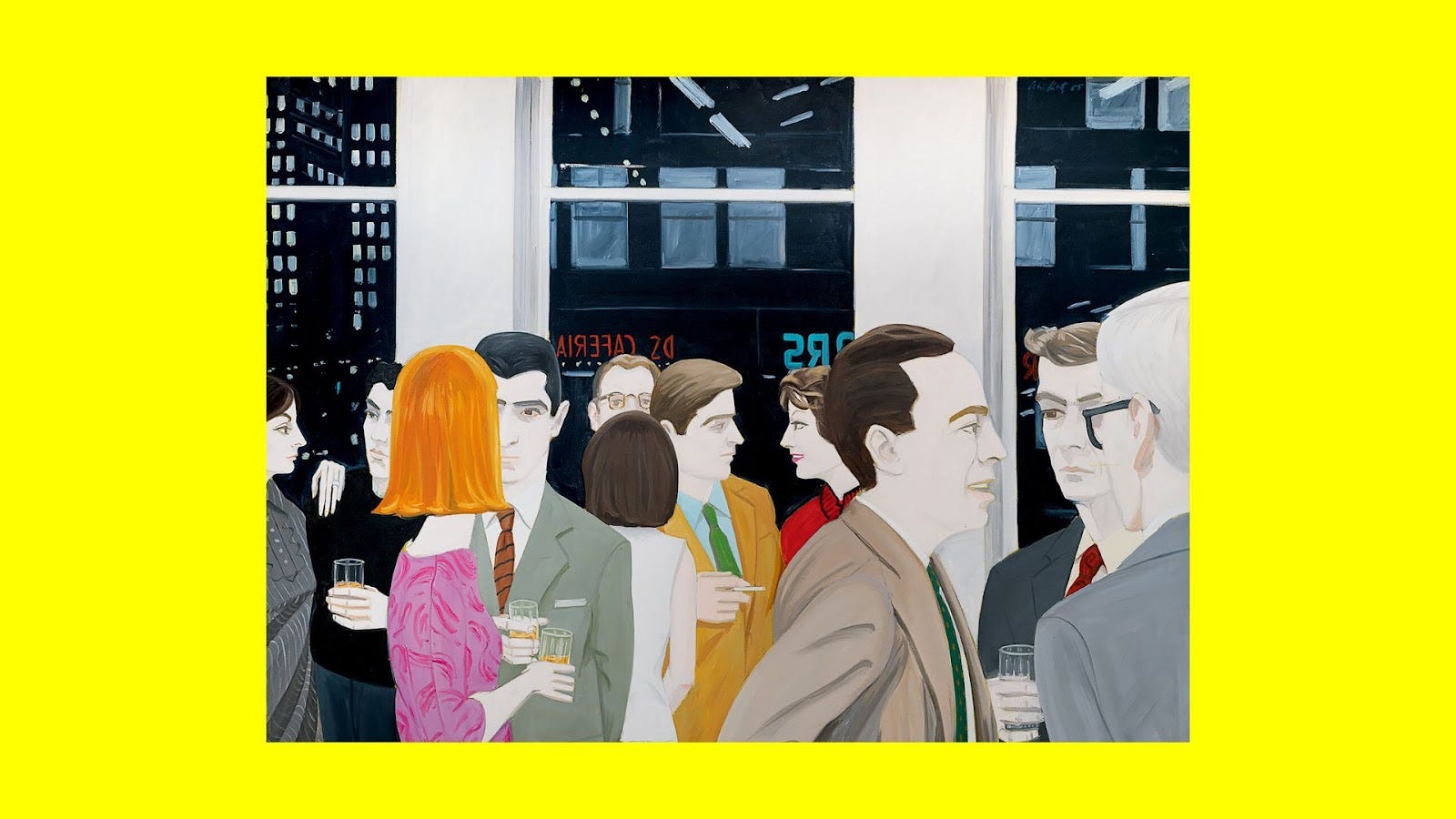
Among Katz's body of work, nothing exemplifies style more than The Cocktail Party (1965). The scene, an urbane Manhattan cocktail party in a high-ceiling, white-walled, SoHo loft, feels like a rarified fantasy. The attendees could be Norman Mailer, Gore Vidal, and Robert Rauschenberg – their conversation ping-ponging between the visual arts, politics, and “the novel” while the perspiration from martini glasses trickle through their fingers. It is a particularly stylish scene not necessarily because everyone is dressed impeccably, with Katz's color composition elevating everyone's sartorial choices, but because the figures are cool, distant, and exalted. They are apart from the dark city in the background.
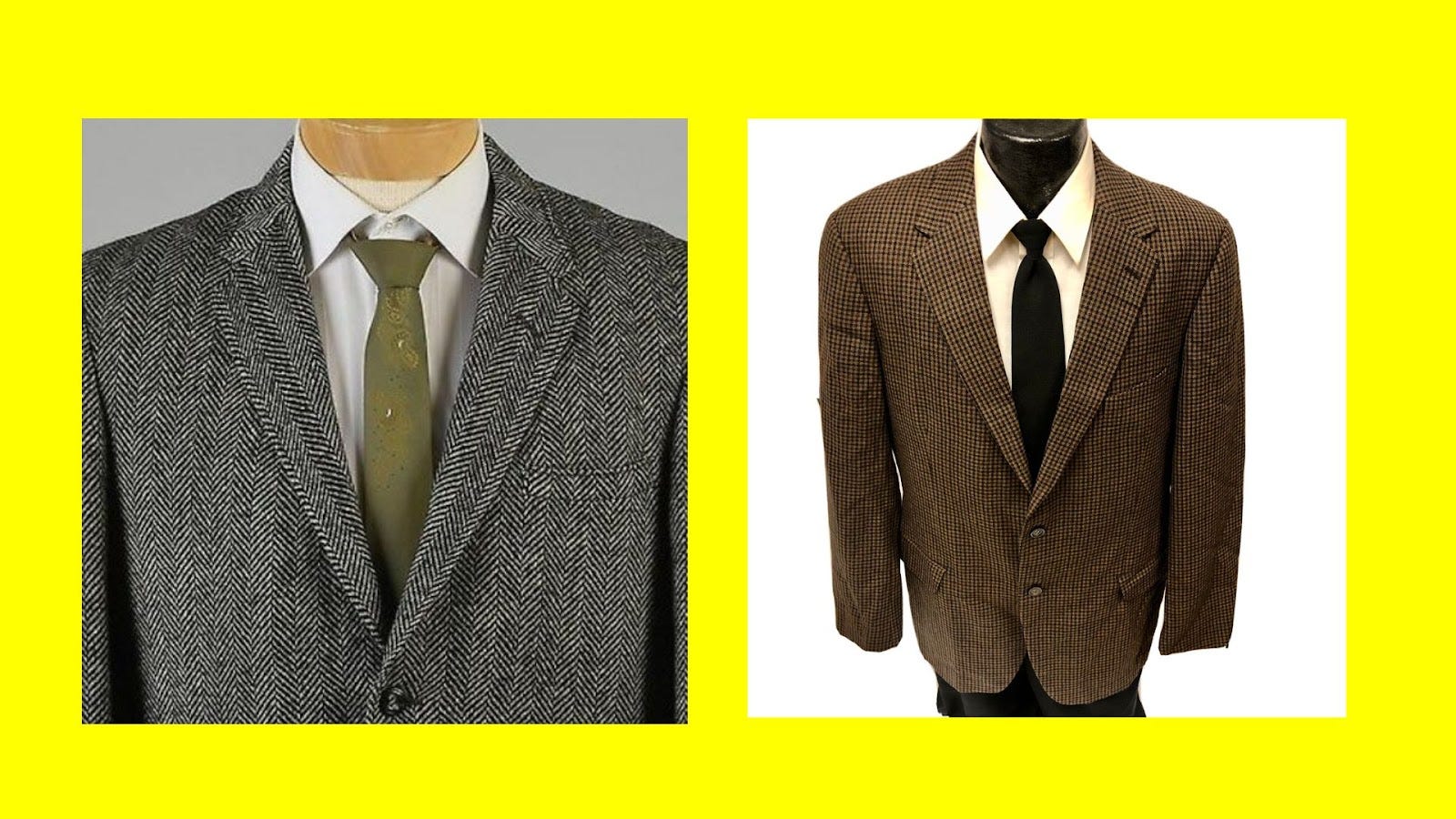
The centerpiece of the midcentury Manhattan sophisticate is the jacket. These two are both in excellent condition. On the left, we have a 1960s Herringbone tweed jacket from Sears, a certified FIRE🔥 brand over here at FIRE SALE. On the right, is an equally relaxed yet refined brown wool tweed blazer made in Yorkshire. My one piece of advice when it comes to styling jackets like these is to search for a contemporary look. It is fashionable to evoke the past, but you don’t want to be in Don Draper drag.
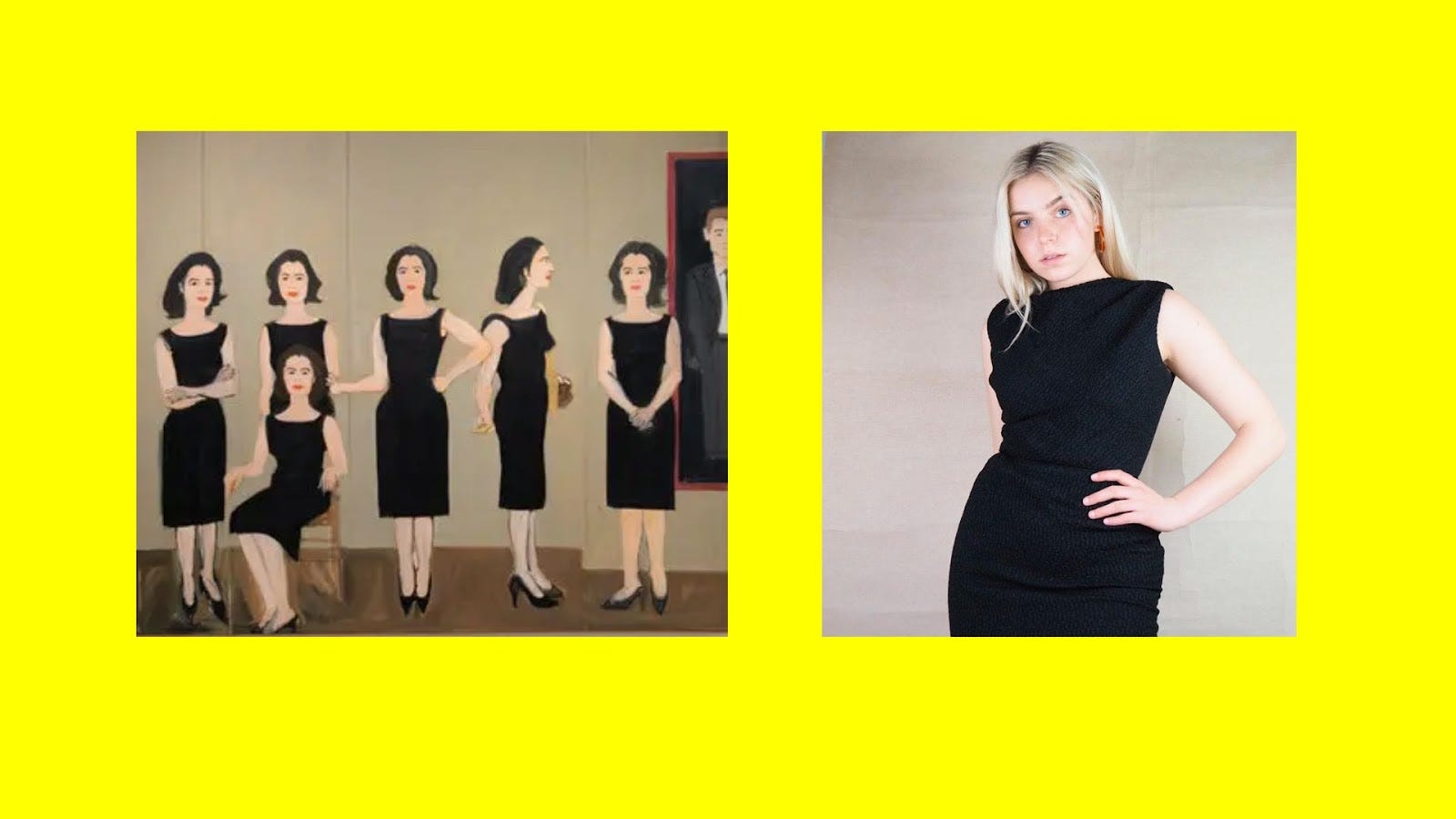
Katz’s greatest muse is his understated, slightly serious, slightly wry, complex, and beautiful wife, Ada. She has been the focus of hundreds of portraits, and Katz never ceases to find a new way of interpreting the depth of her eyes or the subtle multiplicity of her expression. In The Black Dress (1960), Katz depicts Ada in a classic cocktail dress from six different perspectives in one frame. This stunning black rouche dress will help you channel Ada’s je ne sais quoi.
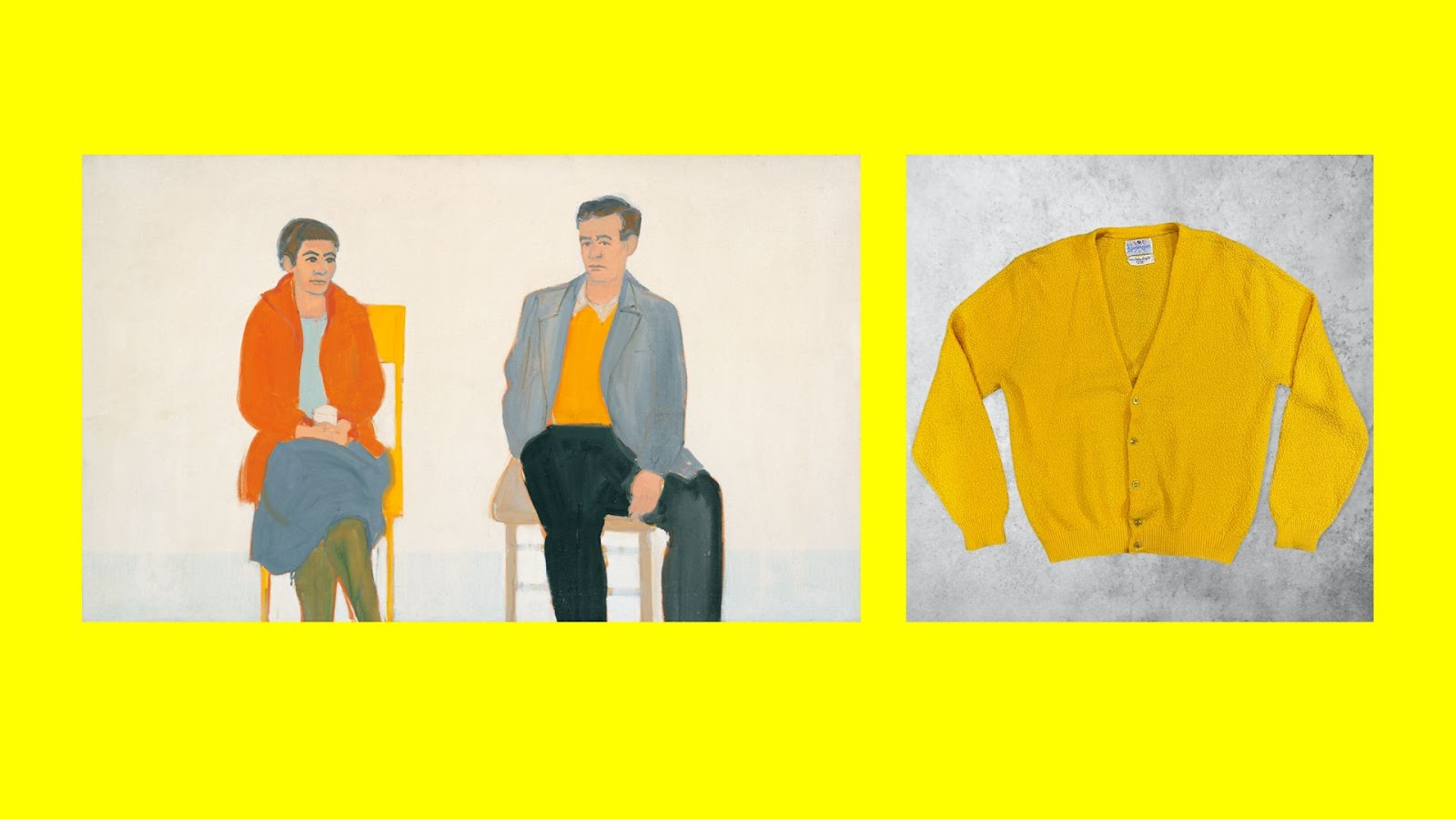
I love the mustard color of the gentleman’s sweater in Rudy and Edith (1957) and found this beautiful knit cardigan from the same era. This simple portrait illustrates Katz's mastery of color and balance in his early career and gives the viewer an excellent example of styling simple, yet deceptively difficult color palettes. This painting, and the expert composition of the figures, is just one example out of hundreds of Katz pieces that can inspire a truly masterful preppy outfit that succeeds not because of luxurious statement pieces but because of color. In his work, you will find the shared DNA of Brooks Brothers and Ralph Lauren but with a beatnik spirit.
I want to leave you with an interview of Katz talking New York City real estate and founding the second artist coop in SoHo more by accident than intent.